Claim extraction
Ingest a pitch deck or IC memo (PDF, TXT, MD) and pull out every impact claim, classified as outcome, output, activity, intent or risk — with the source text kept alongside it.
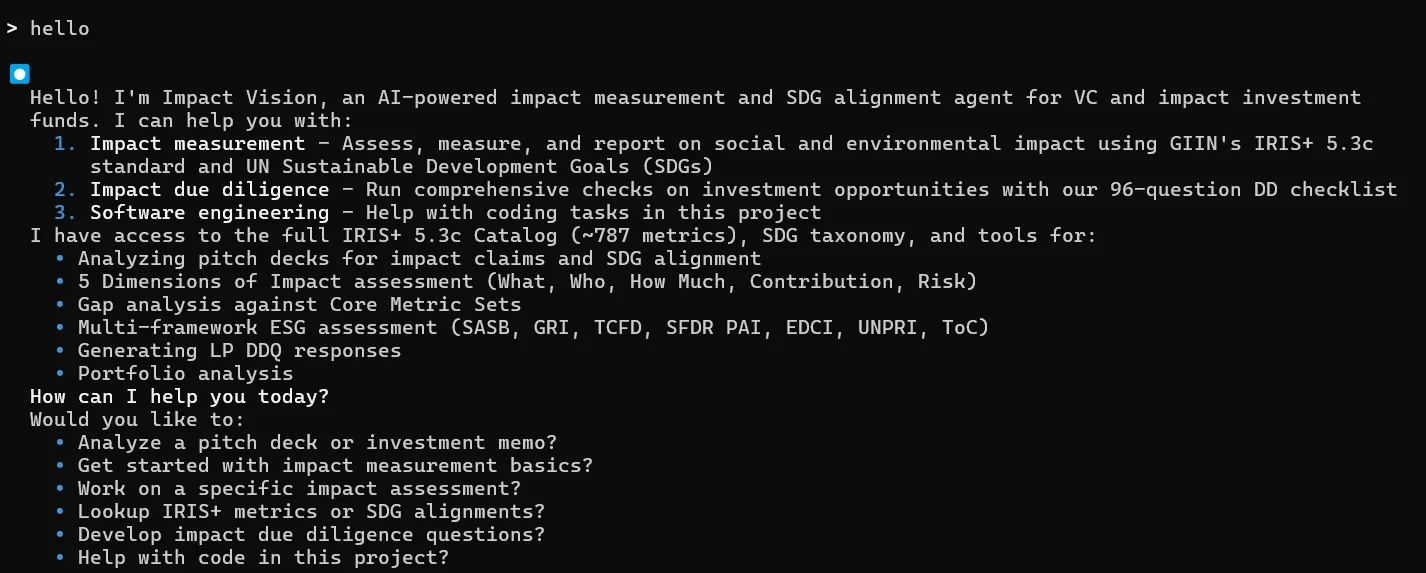
Impact Vision is an open-source, AI-powered impact measurement and SDG alignment engine for venture and impact funds. It reads the pitch deck, maps the claims to IRIS+ and the SDGs, scores the five dimensions, rates the evidence — and tells you which questions to ask next.
Point it at a document. It reads the deck, pulls out and classifies every impact claim, matches them to IRIS+ metrics, scores SDG alignment and the five dimensions, rates the evidence against NESTA levels, runs the greenwashing screen — and writes an interactive report you can hand to an investment committee.
Then it tells you the follow-up questions that would actually change the score. That last part is the difference between a report and a diligence tool.
Every deck says it is transforming something. Very few say what changes, for whom, how much, whether it would have happened anyway, and what could go wrong. That gap is where greenwashing lives — and where regulators, LPs and the SFDR, CSRD and UK FCA anti-greenwashing rules are now looking.
The discipline to close it already exists: IRIS+, the SDG targets, the five dimensions of impact, NESTA's standards of evidence. What has been missing is a tool that applies all of it to a real document in minutes instead of weeks — and shows its work.
Impact investing means investing with the intention to generate positive, measurable social and environmental impact alongside a financial return. Not philanthropy. Not traditional investing with a nice slide. Both, evidenced.
Impact is a by-product nobody measures.
Capital is spent, not recycled.
Which is exactly the part Impact Vision automates: mapping, scoring, evidence rating and the paper trail behind each number.
One command runs the whole chain. Every step is also available on its own — as a CLI call, a Python function, a REST endpoint or an MCP tool.
Point the agent at a pitch deck, memo or data room. It reads the document and auto-extracts a structured company model you can reuse across every downstream tool.
Every impact claim is pulled out and typed — outcome, output, activity, intent, risk — so “we will transform food systems” never gets counted as a measured result.
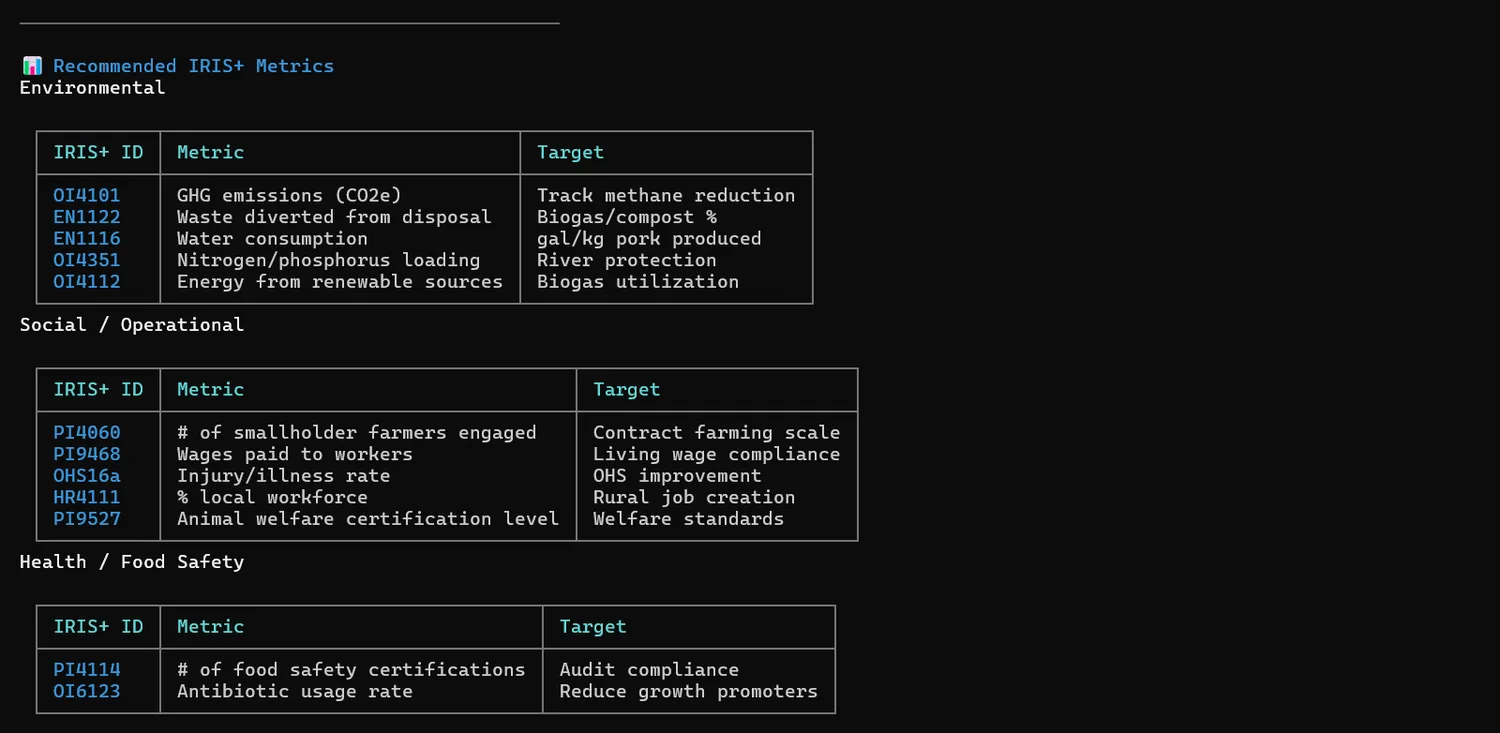
Claims are matched to IRIS+ metrics, SDG goals and targets, and cross-referenced across 59 concepts spanning GRI, SFDR PAI, SASB, TCFD, ESRS, ISSB, PCAF and more.
5 Dimensions scoring with counterfactual prompts, NESTA evidence levels 1–5, sector benchmarks, greenwashing indices and a 122-question DD checklist across 34 categories.
The tool returns the follow-up questions that actually move the score, runs a structured Q&A loop with the company, and tracks which answers are verified versus asserted.
Generate an IC memo, DD report, investee portal or LP narrative — then aggregate the portfolio into weighted 5D scores, coverage rates and exit-impact durability.
Pre-screen to portfolio roll-up, IRIS+ to the EU AI Act. No per-seat licence, no data leaving your machine unless you choose a hosted model.
Ingest a pitch deck or IC memo (PDF, TXT, MD) and pull out every impact claim, classified as outcome, output, activity, intent or risk — with the source text kept alongside it.
Match claims to the GIIN IRIS+ 5.3c catalogue — all ~787 metrics ship with the tool — then run gap analysis against the relevant Core Metric Set.
Score alignment to the 17 Goals and 169 Targets with theme inference and an evidence chain, so a claimed SDG has to be earned rather than asserted.
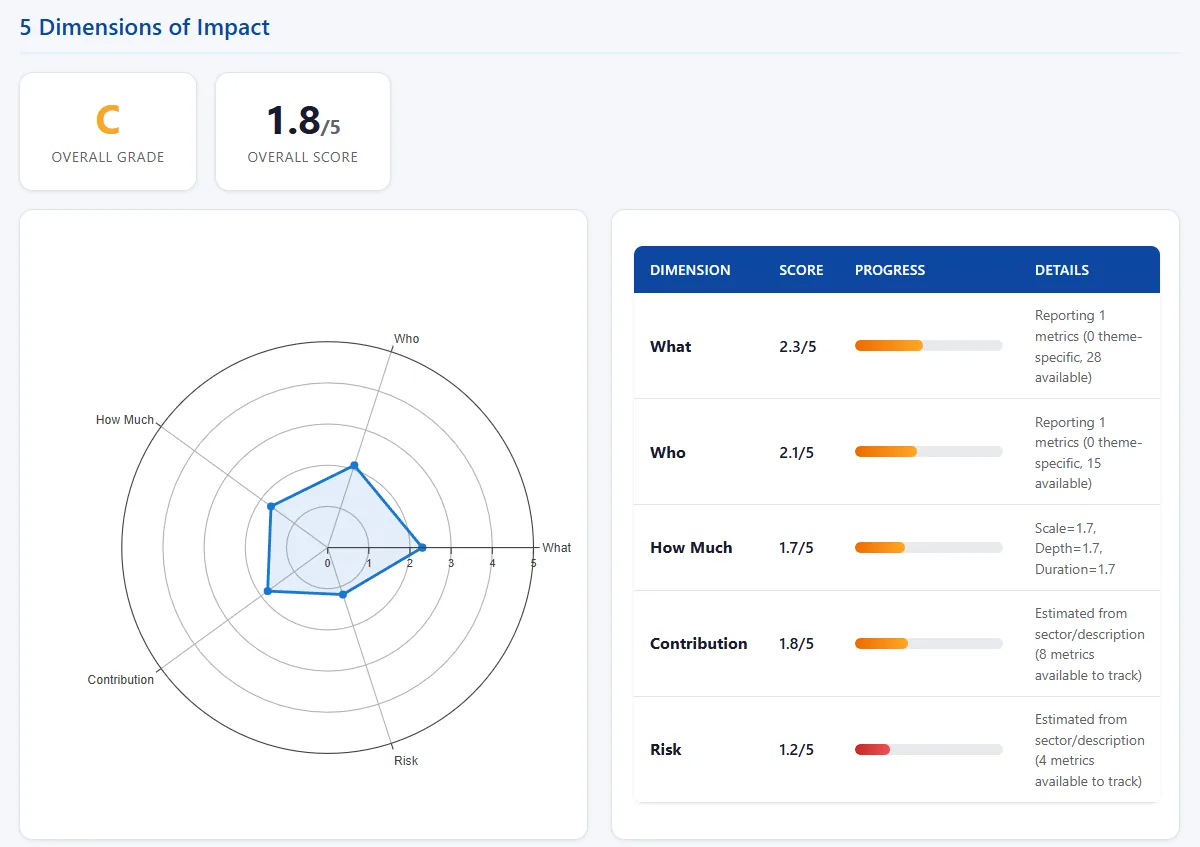
What, Who, How Much, Contribution and Risk — scored with explicit additionality and counterfactual prompts, and benchmarked against GIIN survey data for 18 sectors.
Green Authenticity Index, Cheap Talk Index and a per-claim reviewer that labels each statement concrete, mixed, vague or buzzword-only, with severity and rationale.
Scope 1/2 inventory on a versioned factor catalogue, Scope 3 via PCAF financed emissions, SBTi 1.5 °C pathway checks, TNFD LEAP and NGFS scenario exposure.
SFDR Article 6/8/9 with 14 mandatory PAI indicators, CSRD/ESRS double materiality, CSDDD human-rights due diligence, EU Taxonomy DNSH, UK FCA anti-greenwashing.
SROI with deadweight and attribution adjustments, impact-adjusted IRR, IFVI/VBA value factors, and a QALY welfare quantifier with cost-per-QALY roll-up.
Interactive HTML reports with Plotly charts, IC memos, DD questionnaires, LP DDQ exports, investee portals and portfolio roll-ups — HTML, XLSX, CSV, JSON, PDF.
SDG scoring runs on inferred themes and an evidence chain back to the source text — with official UN goal colours carried through into every generated chart and report.
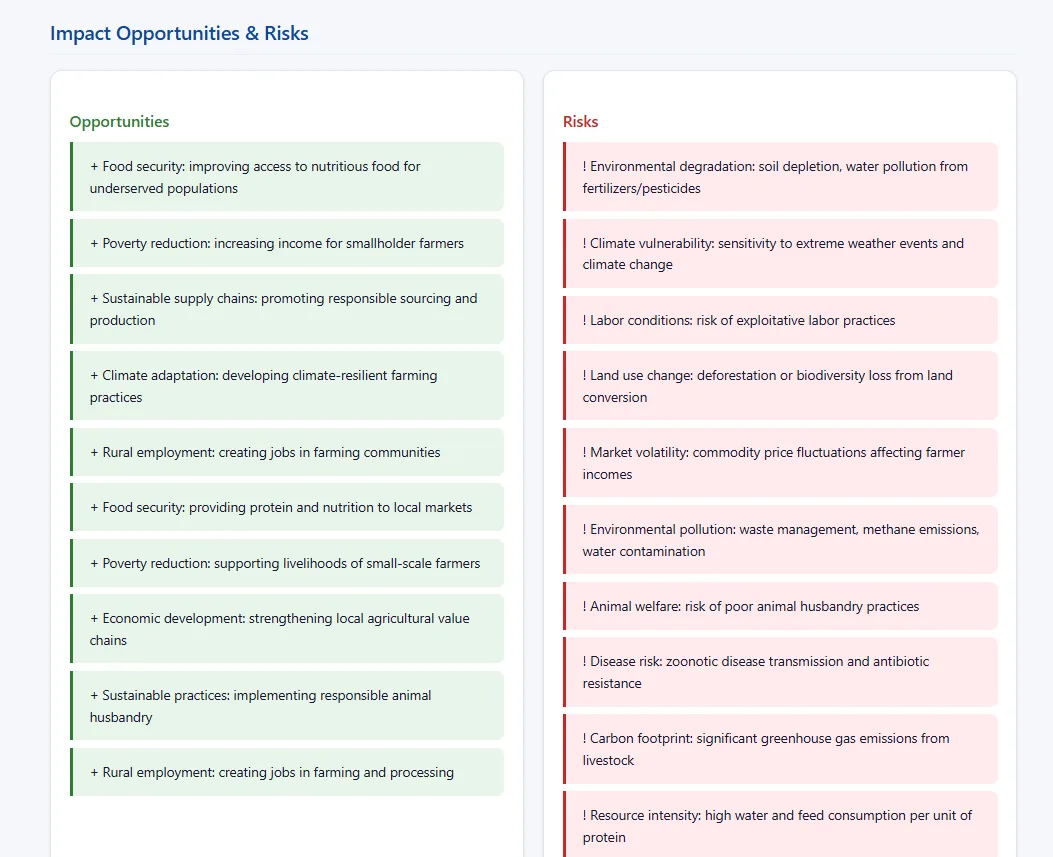
59 concepts mapped across IRIS+, GRI, EDCI, SFDR PAI, SASB, TCFD, ESRS, ISSB, PCAF, SBTi, TNFD, CDP and the EU Taxonomy — so one answer satisfies several disclosures.
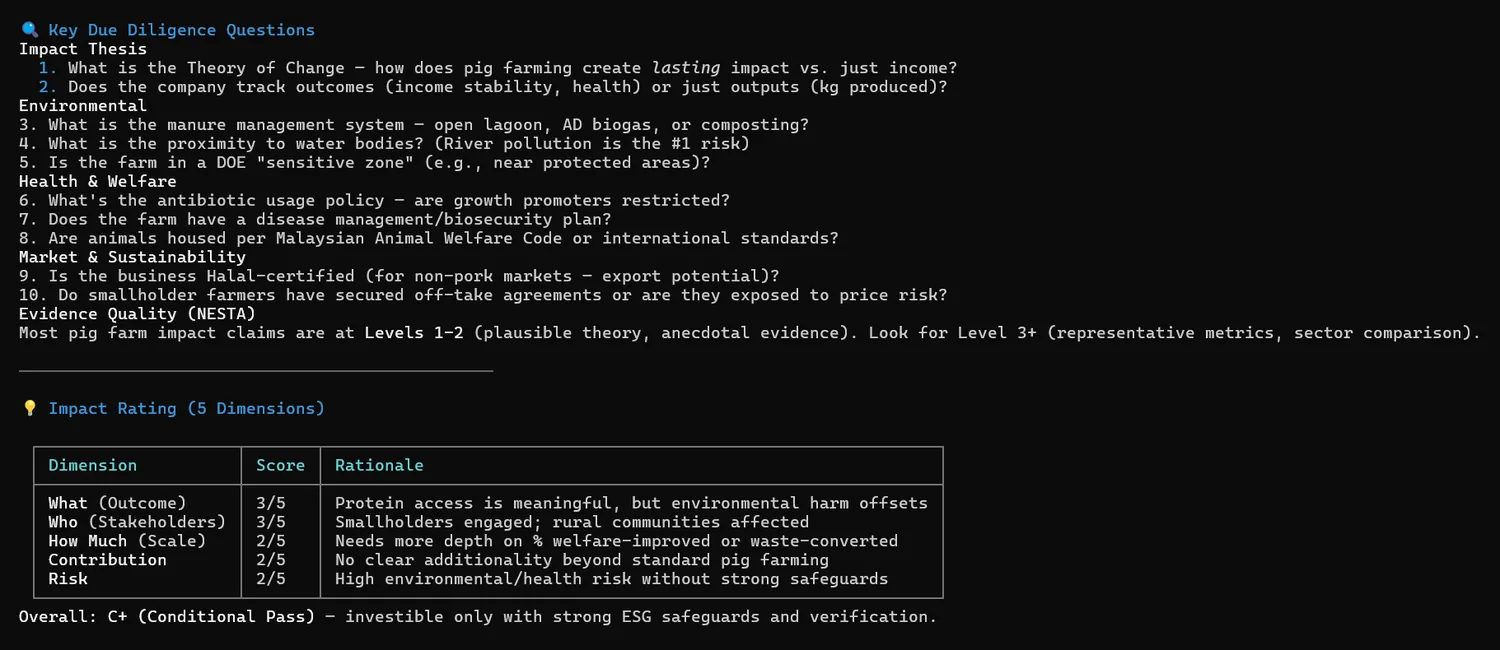
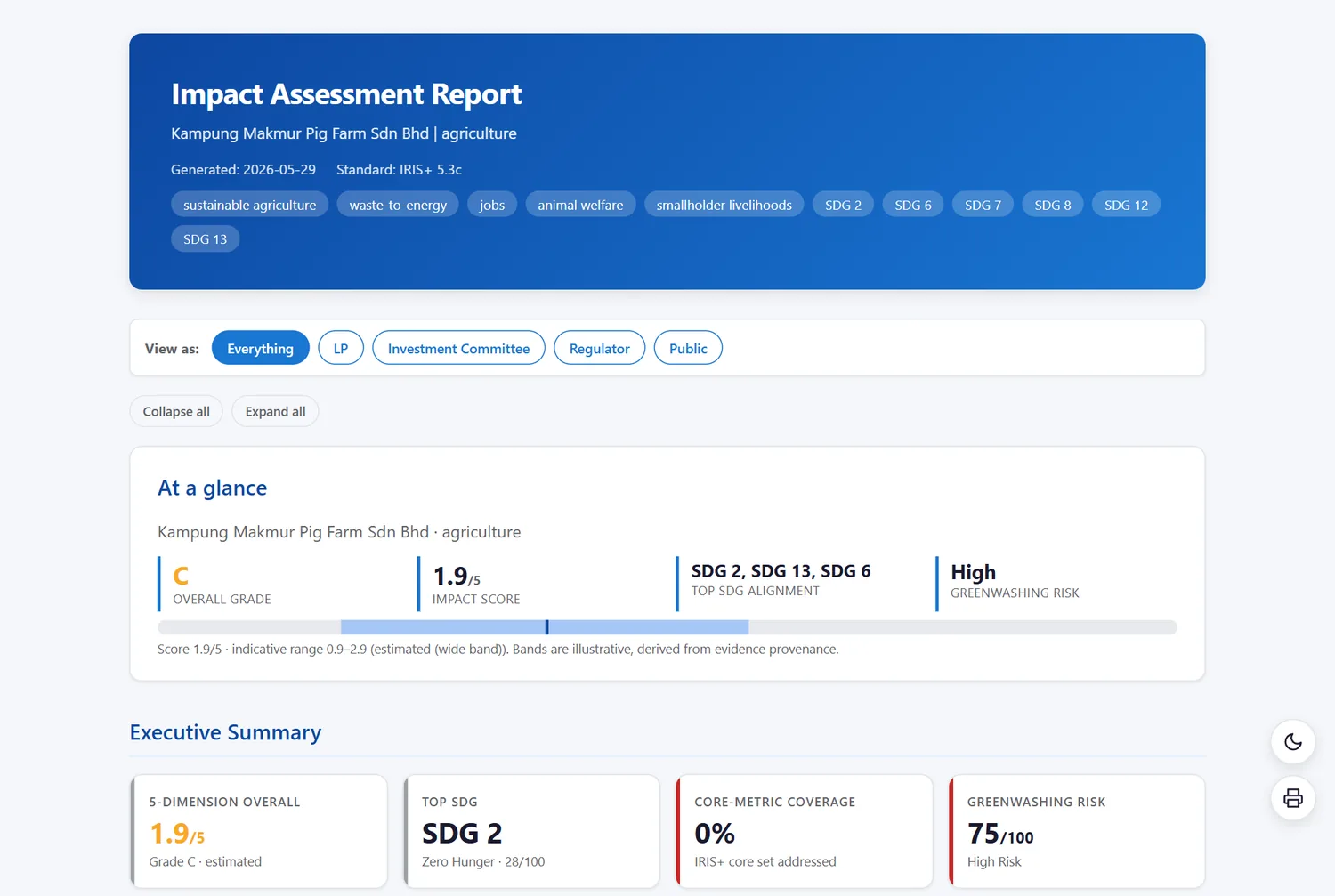
Six deliverables generated end-to-end for a real-world case — a pig farm in Malaysia. Full impact report in light, dark and white-label themes, an IC memo, a DD report and an investee portal. All interactive, all in your browser.
Clone the repo, point it at a model, drop in a deck. No account, no seat licence, no data hostage. Bring your own OpenAI, Anthropic, OpenRouter or local Ollama model.